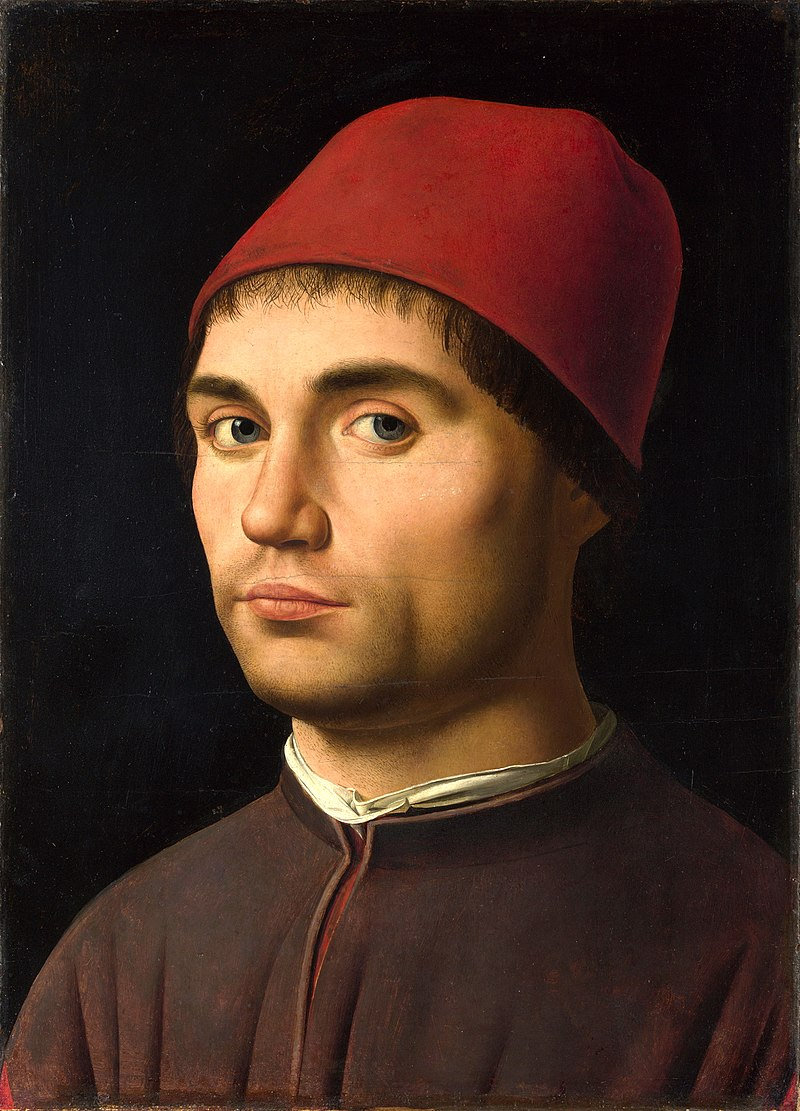
Admiring the works of Antonello da Messina in person in Sicily is one of the reasons to visit this region. Indeed, Antonello is undoubtedly one of the most famous Sicilian artists in the world. His works are displayed in the most important museums worldwide, such as the Musée du Louvre in Paris, the National Gallery in London, the Gemäldegalerie in Berlin, and the Metropolitan Museum of Art in New York. There are six paintings in Sicily, including two of his most famous portraits: the Annunciation of Palermo and the portrait of a man from Cefalù.
Antonello da Messina: Life, Training, and Style
Antonio di Giovanni de Antonio, known as Antonello da Messina, was born in Messina around 1430. His father, Giovanni de Antonio, was a mason, and Antonello likely learned his initial understanding of perspective from him. Around 1450, Antonello moved to Naples to visit the workshop of the painter Colantonio. Here, he learned Flemish, Spanish, and Provençal painting, which would influence his style throughout his career. Studying the works of Piero della Francesca also proved crucial. He adopted the perspective rigor and volume of the Tuscan painter. After returning to Messina, Antonello opened his workshop, which was already in full swing by 1457. However, at the end of 1474, he traveled to Venice again, where he came into contact with the painting of Giovanni Bellini. After his return to Messina, he passed away in 1479.
Antonello da Messina's Works in Sicily
Antonello da Messina's works that can be admired in Sicily are divided into six locations: Messina, Siracusa, Palermo, and Cefalù. The attribution of these paintings to the Messina painter has been possible thanks to Antonello's signature or official documents such as commissioned contracts. There are also other works that some scholars have suggested attributing to Antonello, like the Saint Zosimus in the Cathedral of Siracusa. All of Antonello's paintings found in Sicily were created by the painter during his stay on the island between 1465 and 1475. To see the return of the two-faced panel to Sicily, now in the Regional Museum of Messina, one had to wait until 2003. It was acquired at Christie's auction by the Sicilian Region for a sum of £220,000.