The Feast of Gesù Nazareno in San Giovanni Gemini: Sicily’s Majestic Triumph of Faith, Folklore and Living Tradition
There are moments in Sicily when time does not simply pass: it returns, it gathers, it rises again through the voices of a community, the sound of bells, the scent of flowers, the rhythm of a brass band and the silent intensity of thousands of eyes turned toward the same sacred symbol. The Feast of Gesù Nazareno in San Giovanni Gemini, in the province of Agrigento, is one of those rare moments.
From Friday 12 June to Monday 15 June 2026, San Giovanni Gemini becomes the stage of one of the most extraordinary celebrations in Sicily: a powerful encounter between Christian devotion, collective memory, craftsmanship and spectacular popular ritual. The official 2026 celebrations run from 7 to 15 June, with the most awaited events concentrated between Friday and Monday, including the procession of the Holy Cross, the scinnuta and acchianata of the Triumphal Cart, the votive candles procession and the closing thanksgiving rites.
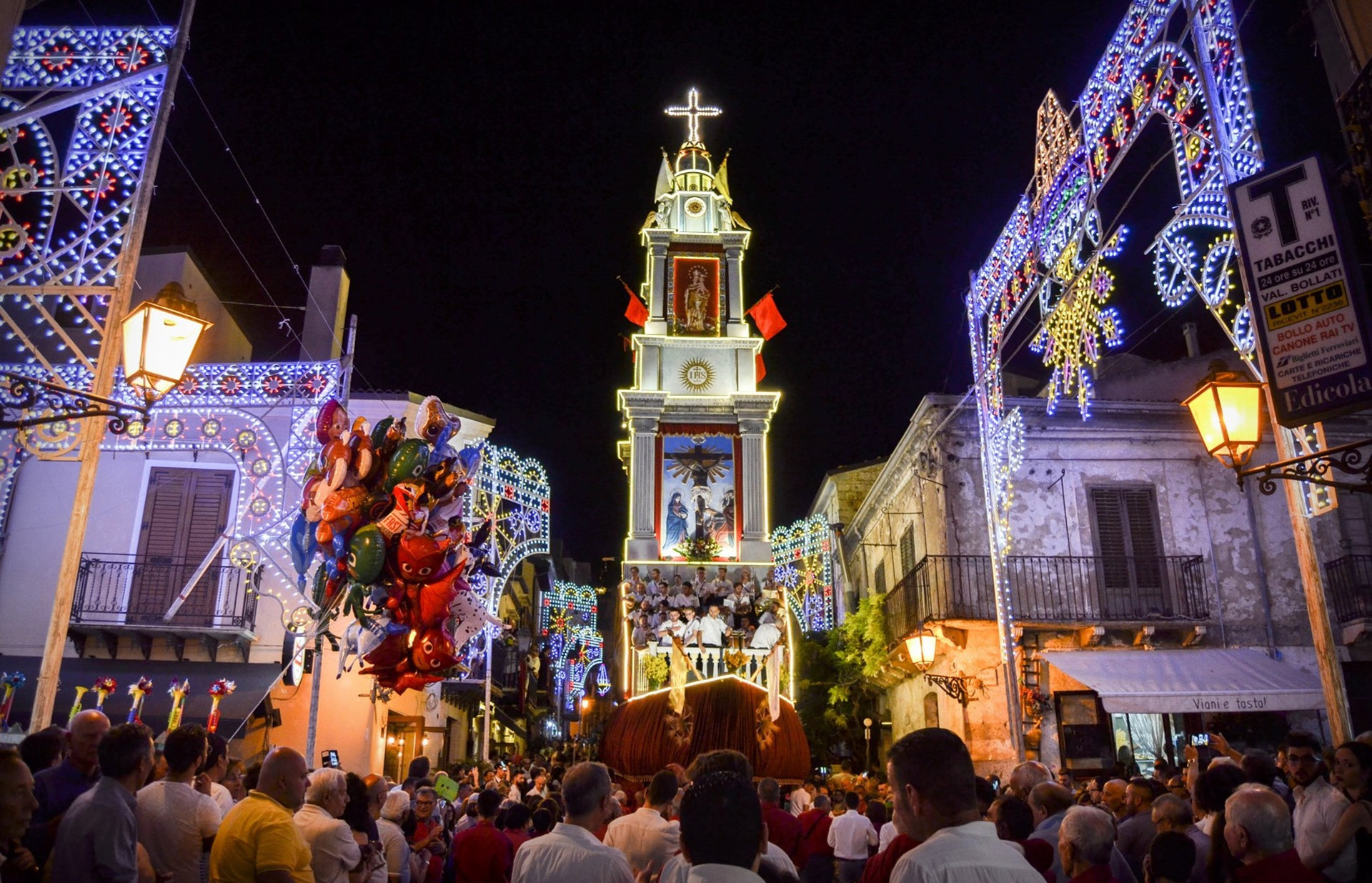
At the heart of the feast stands the Carro Trionfale, the monumental Triumphal Cart dedicated to Gesù Nazareno. It is not merely a decorated structure, nor simply a religious machine moved through the streets. It is a living architecture of faith: a wooden tower rising toward the sky, a symbolic vessel carrying centuries of devotion, a masterpiece of communal energy pulled and guided by the people themselves. The Municipality of San Giovanni Gemini describes it as the largest moving triumphal cart on the island, traditionally drawn along a route of about 400 metres, symbolically preceded by oxen and physically controlled by devotees through a rope around 80 metres long.
For travellers seeking the most authentic Sicily, this is not an event to observe from a distance. It is an immersion into the deep cultural soul of the island. It is Sicily as Great Sicily loves to reveal it: noble, intense, ancient, emotional and profoundly alive.
A Celebration in the Heart of Inland Sicily
San Giovanni Gemini lies in the inland province of Agrigento, in a territory where Sicily changes rhythm. Far from the immediate postcard image of beaches and coastlines, this part of the island opens onto mountains, rural landscapes, stone villages, devotional routes and communities that still preserve a strong relationship with ritual, land and memory.
The Feast of Gesù Nazareno is shared with deep participation by the communities of San Giovanni Gemini and nearby Cammarata, whose people have guarded, renewed and transmitted this tradition for generations. The event is religious in essence, but its force goes beyond the boundaries of a single liturgical celebration. It is a social pact, a cultural inheritance and an extraordinary example of how Sicily transforms faith into beauty, movement and collective identity.
Every detail has meaning. The bells announce. The fireworks call. The bands accompany. The oxen precede. The devotees pull. The crowd responds with the ancient cry: “Viva Gesù Nazareno!”
And in that cry, repeated again and again through the streets, there is the entire emotional geography of the feast.
Ancient Origins: A Devotion Born in the Seventeenth Century
The origins of the Feast of Gesù Nazareno are very ancient. Historical references indicate that the celebration was first held in 1677, making it one of the long-standing religious traditions of Sicily. The devotion is connected to the Holy Crucifix of Gesù Nazareno, whose statue was commissioned in 1649 by Francesco Giambruno, the first archpriest of San Giovanni Gemini, and later became the spiritual centre of the community’s religious life.
Popular tradition adds a deeply evocative layer to this story. According to local memory, the statue was found by farmers near the area once known as Puzzillo, today associated with the Pozzo di Gesù Nazareno. From there, it was brought into the town on a cart drawn by oxen and eventually placed in the Mother Church. Whether read through the lens of history or through the poetry of popular devotion, the story speaks of a community that recognised in the image of the Nazareno a presence of mercy, protection and hope.
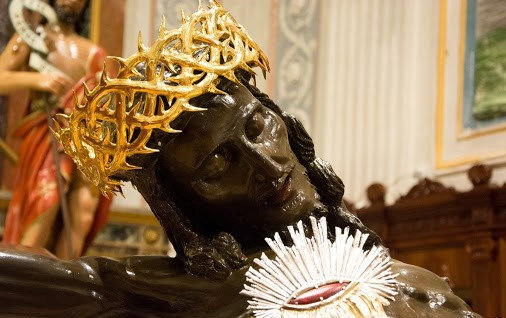
The statue itself is described as a wooden work by an unknown author, with a dark colour and an expression that combines suffering, serenity and tenderness. Around it, the figures of Saint John the Evangelist, Mary Magdalene and Our Lady of Sorrows complete the devotional scene. For the people of San Giovanni Gemini and Cammarata, this is not simply a sacred image. It is a point of return.
It is the place where prayers are whispered, vows are offered, graces are remembered and families reconnect with the deepest roots of their belonging.
The Carro Trionfale: Sicily’s Monumental Moving Symbol
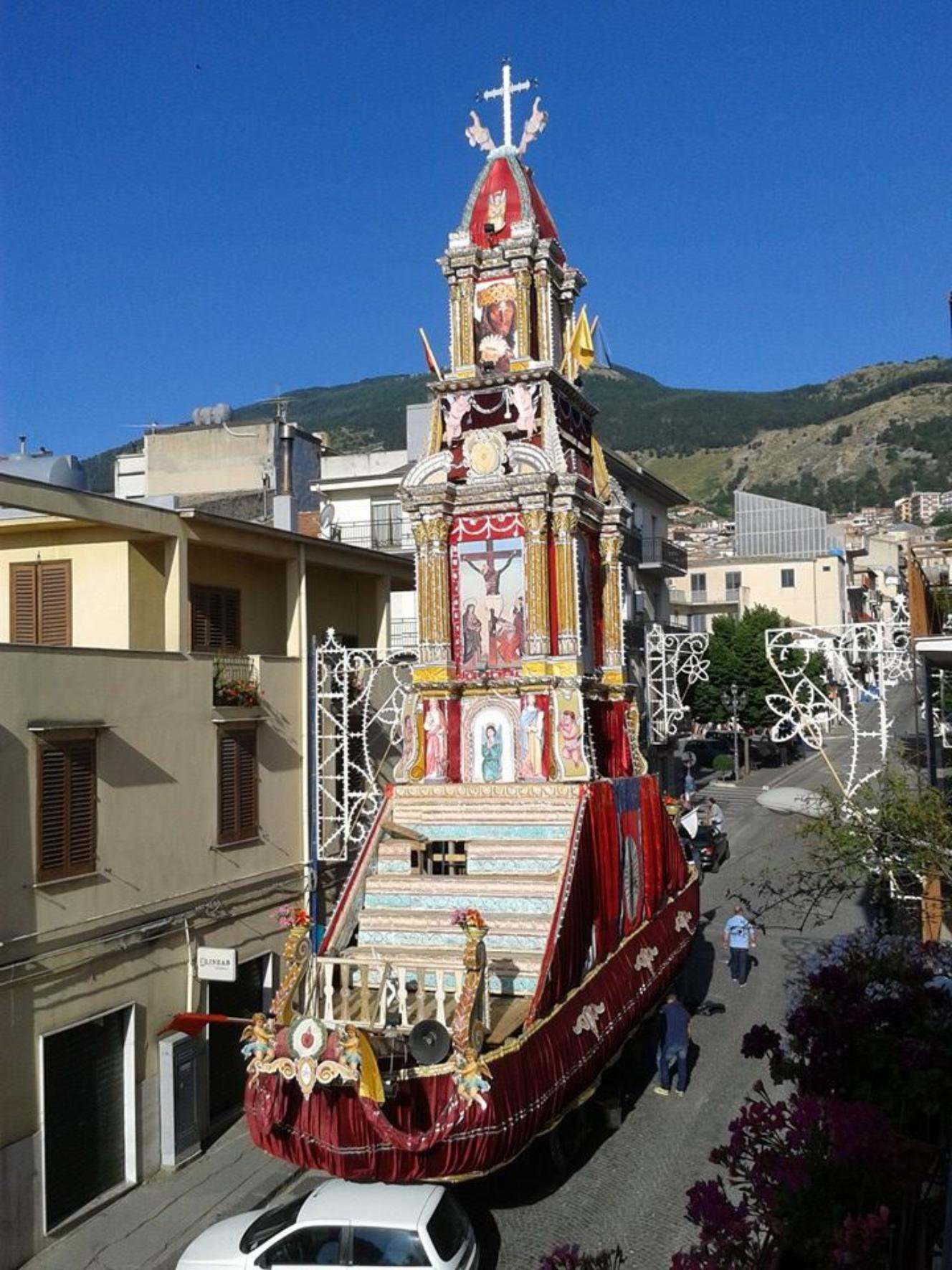
The most spectacular and recognisable symbol of the feast is the Carro Trionfale, the Triumphal Cart of Gesù Nazareno. Its presence dominates the town not only because of its height, but because of what it represents: an entire community building, decorating, guiding and moving a sacred monument together.
The cart reaches approximately 22 metres in height and is among the few Sicilian triumphal carts that have preserved a wooden structure. It is built with a pyramidal vertical form, composed of overlapping quadrangular sections that become smaller as they rise toward the crown and cross at the top. Its base recalls the shape of a boat, while the central tower rises upward like a bridge between earth and heaven.
This symbolism is essential to understanding the emotion of the feast. The boat represents the Church journeying through history, guided by Christ and carried by its people. The tower symbolises the human desire to rise, to seek the infinite, to connect the visible world with the divine. The result is a religious architecture that moves, trembles, advances and breathes with the strength of the crowd.
During the procession, the cart is preceded by a pair of oxen, beautifully decorated according to tradition. Yet the real physical force comes from the devotees, who hold and control the great rope, the corda mastra, around 80 metres long. It is through this rope that the people pull, slow down, guide and accompany the cart along Corso Francesco Crispi.
For visitors, seeing the Carro Trionfale in motion is unforgettable. Its size is impressive, but its movement is even more powerful. It advances slowly, solemnly, almost impossibly. It seems at once fragile and immense, earthly and celestial, heavy and miraculous.
A Masterpiece of Wood, Ropes, Light and Human Skill
The construction of the Carro Trionfale is itself a ritual. Traditionally, the work begins weeks before the main celebration, when the wood preserved in storage is brought out in the ceremony known locally as the nisciuta di lignama. This moment marks the beginning of an intense period of preparation, craftsmanship and collective attention.
The cart is assembled in the first part of Corso Francesco Crispi, the main street of San Giovanni Gemini. Its technical complexity is remarkable. The wooden structure must be strong enough to carry its height and decorations, but also flexible enough to move along a road that is not perfectly flat or straight. The central beam supports the tower, while the base rests on a resistant frame connected to large spoked wheels.
One of the most important technical and ritual operations is the mmurditura, the binding of the axles and rudder. This takes place during the key days of the feast and consists of securing the structural elements with ropes. The use of rope is not merely picturesque: it allows strength, elasticity and control. The rudder, or timone, is essential to guide the cart’s direction, especially during the descent and ascent.
The result is an astonishing example of traditional engineering. Nothing here is decorative alone. Every rope, beam, wheel and movement has a purpose. Every gesture has been learned, repeated and transmitted.
For Great Sicily, this is one of the most fascinating aspects of the feast: it shows how heritage is not preserved in museums only, but also in the hands of people who know how to build, bind, lift, guide and trust.
The Decoration of the Cart: A Theatre of Colour and Devotion
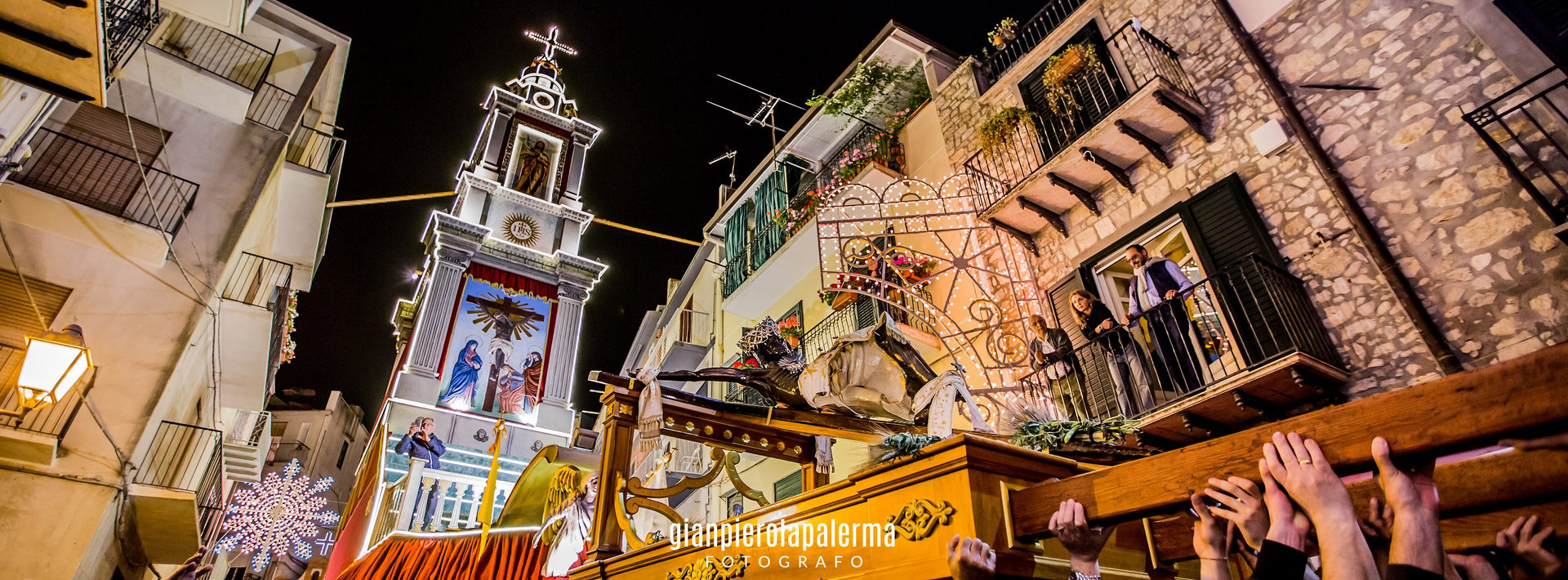
Once the structure is complete, the Carro Trionfale becomes a visual masterpiece. Fabrics, velvet drapes, painted decorations, architectural details, columns, frames, multicoloured flags and sacred images transform the wooden structure into a moving cathedral of colour.
The cart is adorned with images of Gesù Nazareno, the Virgin Mary and the saints venerated by the people of San Giovanni Gemini and Cammarata. At night, the lighting gives the structure an even more dramatic beauty. In recent years, traditional incandescent lighting has been replaced by a more modern system of spotlights and LED strips, creating a suggestive effect that enhances the colours, volumes and verticality of the cart.
The contrast is magnificent: ancient wood and contemporary light, traditional velvet and moving shadows, sacred iconography and festive brilliance. The cart becomes a luminous landmark visible from the crowded street, a vertical sign that gathers attention and transforms the town into an open-air sacred stage.
For photographers, this is one of the most powerful visual moments of the entire feast. The close-ups of the fabrics, the architectural decorations, the flags against the sky, the illuminated tower at dusk and the people gathered around the rope all tell different parts of the same story.
Friday 12 June 2026: The Holy Cross and the Beginning of the Main Feast Days
Friday marks the entrance into the most intense days of the celebration. In the morning, the technical preparation of the cart becomes central with the mmurditura of the axles, one of the crucial operations that prepares the Carro Trionfale for movement. Later in the day, the town begins to fill with music as the band of San Giovanni Gemini enters the streets.
In the evening, the religious atmosphere deepens. After the Rosary and Mass, the Procession of the Crown and the Holy Cross takes place from the Rectorial Church of Santa Lucia to the Mother Church. This is one of the most moving moments for those who wish to understand the spiritual meaning of the feast. The Holy Cross, carried solemnly through the town, opens a path of devotion that will culminate over the following days.
The night continues with the Solemn Vespers and the coronation of the simulacrum of Gesù Nazareno. The sacred image, the people, the authorities, the music and the prayers come together in a ceremony that gives the feast its full devotional intensity.
Friday is the perfect day for travellers who want to enter the celebration gradually. It is less overwhelming than the main cart processions, but rich in atmosphere. It allows visitors to observe the rituals, understand the spaces, meet the rhythm of the community and prepare emotionally for the great spectacle of Saturday and Sunday.
Saturday 13 June 2026: The Maschiata, the Oxen and the Scinnuta of the Carro Trionfale
Saturday is the day when anticipation becomes sound.
At noon, Corso Francesco Crispi is shaken by the maschiata, a traditional sequence of firecrackers and mortar shots that announces the festive route of the cart. This is not simply noise. In local interpretation, the explosions have a ritual value: they mark, purify and prepare the path. The street becomes a sacred corridor, a place where movement, devotion and spectacle are about to meet.
In the late afternoon, one of the most visually distinctive moments takes place in Via Teatro: the vistuta di li vua, the dressing of the oxen. The animals, which symbolically precede the cart, are adorned with traditional velvet trappings, embroidered decorations, golden details and paper flower garlands. The gesture recalls the ancient role of oxen in pulling the cart and preserves a rural memory that remains essential to the feast. The official 2026 programme places this rite on Saturday at 18:30, followed in the evening by the blessing and the scinnuta of the Carro Trionfale.
Then comes the moment everyone has been waiting for: the scinnuta, the descent of the cart.
The crowd gathers. The bands take their positions. The rope is held by the devotees. The oxen stand before the cart. The priest blesses the people and invokes protection for the journey. The air becomes electric. The cry rises: “Viva Gesù Nazareno!”
Slowly, the cart begins to move.
The descent is not a simple procession. It is a collective act of precision and faith. The cart advances in short stages, accompanied by music, applause, prayer, shouting, colour and tension. Those holding the corda mastra must control the weight and rhythm of the structure. Those guiding the rudder must coordinate every lateral movement. The crowd follows with intense concentration, because the cart’s progress belongs to everyone.
For travellers, Saturday evening is one of the most spectacular experiences in Sicily’s calendar of traditional festivals. It is theatrical, but not staged. It is monumental, but intimate. It is ancient, but alive in every second.
Sunday 14 June 2026: Votive Candles, Coronation and the Acchianata
Sunday is the spiritual heart of the feast.
The day begins at dawn with bells, ceremonial shots and the repositioning of the rudder of the Carro Trionfale. At 06:30, the Mass of the dawn opens a long and intense day of devotion. At 07:30, the Solemn Procession of the Crown and Votive Candles takes place, one of the most emotional rites of the entire celebration.
The procession of the votive candles expresses a very personal form of faith. Many devotees walk slowly, sometimes barefoot, holding candles as signs of prayer, gratitude, vows fulfilled or graces received. The atmosphere is different from the triumphant sound of the cart. It is more silent, more interior, more intimate. The town becomes a river of devotion moving toward the Mother Church.
At noon, the simulacrum of Gesù Nazareno is crowned, followed by the solemn Eucharistic concelebration. In the afternoon and evening, the town prepares once again for the movement of the cart.
At 20:30 comes the second great moment: the acchianata, the ascent of the Carro Trionfale.
During the acchianata, the rope that helped control the descent now becomes the instrument of upward movement. The devotees pull the cart back along the route, transforming physical effort into a visible expression of shared devotion. The crowd participates with the same cry, the same emotion, the same sense of belonging.
The acchianata is powerful because it reverses the direction but not the meaning. The cart rises again. The people pull together. The tower moves through the town like a sacred mountain returning to its place. Night lights, music and flags intensify the atmosphere. The official 2026 programme also includes the distribution of small flags late in the evening and a fireworks display after midnight in Via Nicolò Carta.
For visitors, Sunday is the day to experience the feast in its fullest form: dawn devotion, morning procession, solemn liturgy, evening movement, night celebration and final fireworks.
Monday 15 June 2026: Thanksgiving and the Return of the Holy Cross
Monday closes the main cycle of the feast with a quieter but deeply meaningful tone. It is the Day of Thanksgiving. The Mother Church opens in the morning for visits to Gesù Nazareno, followed at noon by the recitation of the Supplication. In the evening, after the thanksgiving Mass, the Procession of the Crown and the Holy Cross returns from the Mother Church to the Rectorial Church of Santa Lucia, accompanied by the final Eucharistic blessing.
This return gives the feast its sense of completion. After the sound, the movement, the crowd and the triumph, Monday brings everything back to gratitude. The Holy Cross retraces the path. The community gathers one last time. The emotion softens, but it does not disappear.
The 2026 programme also includes a cultural closing moment: the screening of the short documentary “E gridammu tutti”, curated by Martina N. Cairone.
For travellers who stay until Monday, the reward is a more intimate understanding of the feast. Not only its spectacle, but its afterglow. Not only the event, but the feeling that remains when the great cart has stopped and the town slowly returns to its ordinary life.
Why This Feast Is One of Sicily’s Most Extraordinary Cultural Experiences
The Feast of Gesù Nazareno is among the most remarkable religious traditions in Sicily because it brings together elements that are rarely found with such intensity in a single event.
It is a religious celebration, rooted in Christian devotion.It is a feat of traditional craftsmanship, centred on a monumental wooden cart.It is a community ritual, made possible by the strength and coordination of the people.It is a visual spectacle, rich in colour, music, light and movement.It is a journey through local identity, where faith, rural memory and Sicilian theatricality meet.
What makes it especially powerful is the relationship between scale and intimacy. The Carro Trionfale is immense, but every hand on the rope matters. The crowd is large, but every prayer is personal. The ritual is public, but the emotion often feels private.
This is the essence of the most authentic Sicily: grandeur without distance, beauty without artificiality, tradition without nostalgia.
The Sounds of the Feast
To understand the Feast of Gesù Nazareno, one must listen.
The first sound is the bell, calling the town to attention. Then come the firecrackers, sudden and rhythmic, breaking the ordinary soundscape and announcing that feast time has begun. The brass bands add another layer: solemn marches, festive melodies, music that follows the movement of the cart and gives emotion a shared rhythm.
Then there is the crowd. The murmur before the movement. The silence before the blessing. The collective shout when the cart begins to move. “Viva Gesù Nazareno!” is not simply an exclamation. It is a declaration of belonging.
And finally, there is the sound of the cart itself: the creaking of wood, the pull of the rope, the movement of wheels, the tension of a structure guided by human hands. It is the sound of heritage in motion.
The Colours of the Feast
The Feast of Gesù Nazareno is also a celebration of colour.
There is the dark, intense colour of the wooden statue of the Nazareno, with its expression of suffering and mercy. There is the gold of the crown, symbol of devotion and kingship. There are the reds, purples and blacks of the oxen’s traditional ornaments, embroidered and decorated for the occasion. There are the multicoloured fabrics of the cart, the banners, the small flags, the flowers, the lights and the confetti-like paper notes that animate the air.
At dusk, the colours change again. The sky becomes deeper, the cart lights come alive, the crowd becomes a moving shadow around the illuminated structure. This is the ideal moment for photography: the moment when devotion becomes almost cinematic.
The Human Side: Devotees, Families and Returning Emigrants
Like many great Sicilian feasts, the celebration of Gesù Nazareno is also a moment of return.
People who live elsewhere come back to San Giovanni Gemini and Cammarata for these days. Families reunite. Streets become meeting places. Balconies fill with faces. Children discover the rituals that their grandparents already knew. Devotees fulfil vows made in moments of difficulty. The elderly watch with the emotion of memory. Young people take their place in the continuity of the feast.
This human dimension is essential. Without the people, the cart would be only a structure. With the people, it becomes a sacred body in motion.
The Feast of Gesù Nazareno is not performed for visitors. Visitors are welcomed into something that already belongs deeply to the community. This is why approaching it with respect is so important. The best way to experience it is not as a spectator searching for spectacle, but as a guest witnessing a living act of faith.
A Great Sicily Experience: For Travellers Who Seek the Real Island
For Great Sicily, the Feast of Gesù Nazareno is the kind of experience that reveals the island beyond conventional travel.
It is not a generic event. It is a destination in itself. It belongs to the Sicily of sacred routes, inland villages, ancient brotherhoods, artisanal knowledge and emotional landscapes. It is ideal for travellers interested in cultural depth, photography, religious heritage, anthropology, slow tourism and authentic local experiences.
For high-end travellers and cultural explorers, this feast offers something increasingly rare: the opportunity to witness a tradition that has not been simplified for tourism. Its power lies precisely in its authenticity. The schedule follows religious time. The movement of the cart follows the rhythm of the community. The emotion is real.
In a travel market often dominated by predictable itineraries, San Giovanni Gemini offers a different Sicily: less obvious, more profound, unforgettable.
Complete Program:
San Giovanni Gemini
7–15 June 2026
Ecclesial Community of San Giovanni GeminiCommittee for the Celebrations of Gesù Nazareno
Sunday, 7 June
Solemnity of Corpus Christi
8:00 a.m.Positioning of the wheels of the Triumphal Cart.
7:00 p.m.Solemn Eucharistic Celebration with the participation of the civil and military authorities, the ecclesial groups and the town committees.
8:00 p.m.Corpus Christi Procession with the participation of the civil and military authorities, the ecclesial groups, the altar servers, the First Communion children and the town committees.
Monday, 8 June
Triduum
Day dedicated to children, young people and expectant mothers
6:30 p.m.Traditional Rosary to Gesù Nazareno.
7:00 p.m.Holy Mass, with the blessing of children, expectant mothers and young people.
Tuesday, 9 June
Triduum
Day dedicated to the sick and the elderly
6:30 p.m.Traditional Rosary to Gesù Nazareno.
7:00 p.m.Holy Mass, with the Rite of the Anointing of the Sick.
Wednesday, 10 June
Triduum
Day of prayer for all deceased members of the Committee
5:30 p.m.“Mmurratura di corda” at the Triumphal Cart.
6:30 p.m.Traditional Rosary to Gesù Nazareno.
7:00 p.m.Holy Mass, followed by the oath of the novices and active members.
Thursday, 11 June
Night Pilgrimage
6:00 a.m.Gathering at the Church of Santa Maria di Gesù in Cammarata and departure.
2:00 p.m.Blessing of the fire and “Quartu Cantu”, accompanied by torches, with arrival at the Well of Gesù Nazareno.
6:00 p.m.Blessing of motorcycles and cars in Corso Francesco Crispi.
6:30 p.m.Traditional Rosary to Gesù Nazareno.
7:00 p.m.Holy Mass with the participation of farmers and the offering of the fruits of the earth.
9:30 p.m.Presentation of the Triumphal Cart.
Friday, 12 June
7:30 a.m.“Mmurrditura” of the axles of the Triumphal Cart.
5:00 p.m.Entrance of the “G. Puccini” Music Band of San Giovanni Gemini.
6:30 p.m.Traditional Rosary to Gesù Nazareno.
7:00 p.m.Holy Mass.
8:00 p.m.Procession of the Crown and the Holy Cross, from the Rectorial Church of Santa Lucia to the Mother Church.
9:30 p.m.Solemn Vespers and Coronation of the simulacrum of Gesù Nazareno, with the participation of the civil and military authorities.
Saturday, 13 June
7:30 a.m.“Mmurrditura” of the rudder of the Triumphal Cart.
12:00 p.m.Traditional “Maschiata” in Corso Francesco Crispi.
5:00 p.m.Entrance of the “V. Bellini” Music Band of Cammarata.
6:30 p.m.Blessing and “Vistuta di li vua” in Via Teatro, curated by the Lombino family.
7:00 p.m.Prefestive Holy Mass.
8:15 p.m.Distribution of small flags.
8:30 p.m.Blessing and “Scinnuta” of the Triumphal Cart.
Sunday, 14 June
Solemnity of Gesù Nazareno
6:00 a.m.The melodious ringing of the bells announces the joyful feast day.Firing of ceremonial shots and repositioning of the rudder of the Triumphal Cart, followed by the “mmurrditura”.
6:30 a.m.Dawn Holy Mass.
7:30 a.m.Solemn Procession of the Crown and the Votive Candles.
9:00 a.m.Holy Mass.
12:00 p.m.Coronation of the simulacrum of Gesù Nazareno.
12:15 p.m.Solemn Eucharistic Concelebration, presided over by the Archpriest, with the participation of the civil and military authorities.
5:30 p.m.Holy Mass.
6:00 p.m.“Vistuta di li vua” in Via Teatro, curated by the Lombino family.
7:30 p.m.Holy Mass.
8:30 p.m.“Acchianata” of the Triumphal Cart.
11:30 p.m.Distribution of small flags.
12:00 midnightFireworks display.
Monday, 15 June
Day of Thanksgiving
9:00 a.m.Opening of the Mother Church and visit to Gesù Nazareno.
12:00 p.m.Supplication to Gesù Nazareno.
7:00 p.m.Thanksgiving Holy Mass to Gesù Nazareno.
8:00 p.m.Procession of the Crown and the Holy Cross, with the participation of the committees, from the Mother Church to the Rectorial Church of Santa Lucia, followed by Eucharistic Benediction.
9:30 p.m.“E gridammu tutti” — screening of the short documentary curated by Martina N. Cairone.
The ArchpriestDon Gianluca Accardi
The Committee for the Celebrations of Gesù Nazareno
Practical Notes for Visitors
Visitors planning to attend the Feast of Gesù Nazareno should arrive early, especially on Saturday and Sunday evenings, when the scinnuta and acchianata attract large crowds. Comfortable shoes are essential, as the event takes place along the streets of the town and requires standing, walking and waiting.
Respectful clothing is recommended, particularly for those entering churches or attending liturgical moments. During the processions, it is important to avoid obstructing the devotees holding the rope or moving close to the cart’s operational path. Photography is welcome in public spaces, but discretion is always appropriate during moments of prayer, barefoot devotion and religious ceremonies.
The feast is also an excellent opportunity to explore the surrounding area, including Cammarata and the inland landscapes of the Agrigento province. A full itinerary can combine the emotional intensity of the celebration with local gastronomy, rural landscapes and nearby cultural routes.
Where to Stay During the Feast of Gesù Nazareno
During the Feast of Gesù Nazareno, staying as close as possible to San Giovanni Gemini is highly recommended, especially for visitors who want to experience the evening processions, the scinnuta, the acchianata and the fireworks without having to drive late at night.
San Giovanni Gemini and Cammarata are two distinct municipalities, but they are closely connected and form an almost continuous urban area on the slopes of Monte Cammarata. For this reason, staying in Cammarata can also be a very practical choice during the feast.
Accommodation in San Giovanni Gemini
B&B A Due Passi
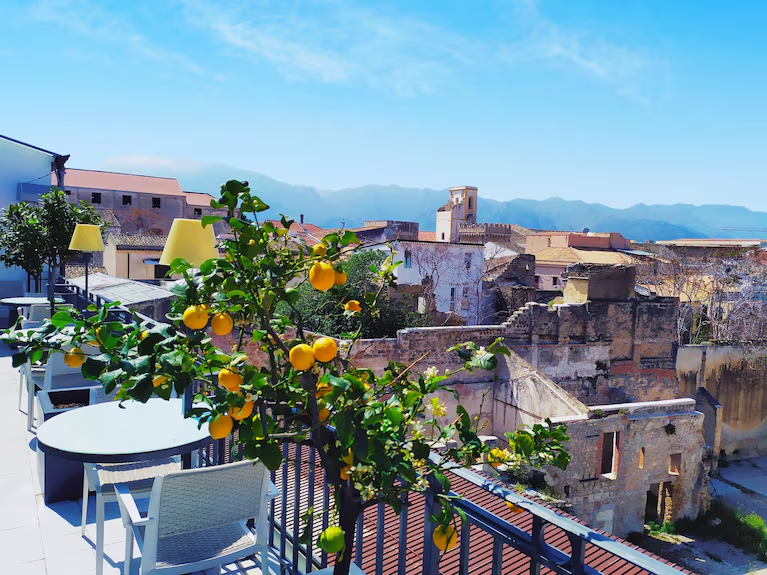
A convenient option in San Giovanni Gemini, suitable for travellers who want to remain close to the heart of the celebration. The property is listed with a terrace, shared lounge, parking facilities and mountain views, with a location close to the town centre.
Sweety House
A practical stay in San Giovanni Gemini, with free Wi-Fi and apartment-style facilities. It is a useful option for visitors looking for independence during the feast days, especially for short stays or small groups.
Dazicalò
A holiday apartment in San Giovanni Gemini with Wi-Fi, kitchen facilities and a balcony. This type of accommodation is ideal for guests who prefer more autonomy than a traditional hotel room.
Cortile Suez
A holiday home in San Giovanni Gemini featuring a garden, terrace, bar area and free Wi-Fi. A good solution for travellers looking for a more private and relaxed stay during the festival weekend.
B&B Mammamia
A B&B option in San Giovanni Gemini, listed on travel platforms and located not far from the town centre. Before including it in a final travel itinerary, availability should be checked directly.
Il Carro Comfortable Rooms
A thematically perfect accommodation for this event, as the rooms are inspired by parts of the Carro Trionfale, including names connected to the cart’s structure. The property describes modern rooms with Wi-Fi, en-suite bathrooms, private balconies and a shared lounge. However, for June 2026 it should be verified directly before publication, because one third-party listing reports a temporary closure during the summer period.
Accommodation in Cammarata
Halykos Hotel
One of the most structured hotel options in Cammarata, suitable for visitors who prefer hotel-style services. Listings describe it with family rooms, air conditioning, private bathrooms, city views, free private parking, garden areas and shared spaces.